
If Xi Jinping can establish control over the PLA Ground Force, relations between India and China will settle down to an even keel. The next few weeks will show whether Xi has finally succeeded in gaining control over the PLA Ground Force. That could bring about the substantive shift in India-China relations that both our leaders have been working for, observes Ambassador Prabhat Shukla.

Two former Chinese defence ministers, Wei Fenghe and Li Shangfu, were sentenced to death with a two-year reprieve over graft charges, official media reported.
'For the first time in a hundred years, the army has been taken out of the political equation. And for the first time ever, there is only one man who calls the shots. Not even Mao had this kind of power.'
If Xi Jinping is dethroned in the future, the instrument for that may well be embedded within the PLA, notes former foreign secretary Shyam Saran.

Vice Admiral Li Hanjun, chief of staff of the People's Liberation Army Navy (PLAN), and Liu Shipeng, deputy chief engineer of China National Nuclear Corporation, have been expelled from the National People's Congress (NPC), the Hong Kong-based South China Morning Post reported.
A new military rank system had been introduced for the PLA, but all soldiers must always obey the Communist party, reveals Jayadeva Ranade, the distinguished China expert and retired RA&W officer.

To rise quickly in the PLA's hierarchy, you need to be close to Xi Jinping. Retired RA&W officer Jayadeva Ranade on the changes in China's military leadership.

'Tibetans will participate in future conflicts with India (in all probability, some were already present in Galwan).' 'As nobody in India would like to have a deadly fight with Tibetan soldiers and officers, the issue needs to be closely followed,' observes Claude Arpi.
The first priority for the new Tibetan administration in Dharamsala should be to look at Tibetan recruitment in the PLA, suggests Claude Arpi.

China's 2.8 million strong People's Liberation Army, the world's largest standing military, would continue to be part of ruling Communist Party of China, and resolutely oppose any attempt to separate from it, a military official said on Tuesday.

Speculation about the missing Chinese Defence Minister General Li Shangfu may have been removed and detained became rife after he was conspicuously absent at the meeting of the Central Military Commission (CMC) in Beijing on Friday.

The 2.3 million strong People's Liberation Army, the world's largest, adopts a more aggressive posture with massive structural revamp.
Xi ordered country's 2.3 million-strong military to be absolutely loyal to the party, to focus on how to win in wars, to pioneer reforms and innovation, to scientifically manage commanding a unit, to lead troops in accordance with the strictest standards and to take the forefront in complying with laws and regulations.
China also removed Finance Minister Liu Kun and appointed Lan Fo'an in his place. Liu is the third senior Cabinet minister to be replaced without any explanation.

Throughout 2022, China turned to the PLA as an increasingly capable instrument of Statecraft, strengthening its ability to 'fight and win wars' against a 'strong enemy', points out Ajai Shukla.

'The supreme art of war is to subdue the enemy without fighting.' Former RA&W official Jayadeva Ranade explains what China's military reforms mean for the world.

Chinese President Xi Jinping has stressed the need for the recruitment of new talent to support the rapid modernisation of the armed forces and win future wars amid reports that the military has committed more resources to enrol 3 lakh personnel for frontline positions.
President Xi, who heads the Central Military Commission (CMC), the overall high-command of the two million-strong People's Liberation Army (PLA), appointed Gen. Zhang Xudong as the Commander of the Western Theatre Command, according to the official media in Beijing.
'The military officers at China's National People's Congress reflect Xi Jinping's preference for elevating politically reliable, younger, officers with good professional qualifications,' says former RAW officer and China expert Jayadeva Ranade.

Will China's new military reforms endanger Xi Jinping's rule?

'We must understand that the LAC is a political issue for China, so any action on the LAC will keep India focussed on the LAC which gives China the opportunity for any adventurism in the Indian Ocean.'

The arrival a couple of days ago of a Chinese nuclear submarine for the first time in Karachi port, coinciding with a Chinese military delegation's visit, points to Pakistan's importance for China, says former R&AW officer Jayadeva Ranade.

In a few years from now, India will be looking at an entirely different type of military adversary across the borders, in our waters, in the air, in space and in our communication networks, says Nitin Pai.

Two elderly Chinese aerospace experts are hospitalised after a violent attack by a 'Princeling', states Jayadeva Ranade, the distinguished China expert and retired RA&W officer, highlighting the power the 'Princelings' ironically hold in the Communist People's Republic.

'The US will not want to tangle with China landwards.' 'Nor will the US confront the Chinese navy seawards on India's account.'

It will be interesting to see whether India-China border tensions figure during the deliberations of PLA deputies to the NPC and CPPCC, notes Jayadeva Ranade, the distinguished China expert and retired RA&W officer.

'Clarifying that modernisation of national defence and armed forces should be completed by 2035, Xi Jinping asserted the goal is to make the People's Liberation Army a "world class force" that "can fight and win" by 2050,' points out former RAW officer Jayadeva Ranade.
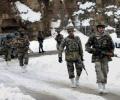
'To deal with a bully, you have to deal from a position of strength, not a position of weakness.'

All that India must aim for is to match China's military prowess adjusted to equal Beijing's India-specific military capability, argues Vivek Gumaste.

'New Delhi showed itself willing -- at least for a period -- to tolerate the risk of conflict and to withstand Beijing's implicit and explicit threats.' 'But it also continued to try to cut some kind of deal with China to reduce tensions.'

'The title of 'core' of the leadership gives Xi Jinping greater political authority at a time when China is beset by various problems as well as a slowdown in economic growth,' points out former RA&W officer Jayadeva Ranade.
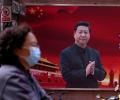
China has not limited the 'battle' to the diplomatic field alone; the People's Liberation Army has become aggressive on the ground too. The recent 'fights' in Northern Sikkim and Ladakh are part of the pattern, asserts Claude Arpi.

What was the need for Xi Jinping, general secretary of the Chinese Communist Party, President of the People's Republic of China and Chairman, Central Military Commission, to don the new role of Commander in-Chief? Does this mean that the most powerful Chinese leader since Mao faces numerous threats from within the Communist Party?

The agreement would divert China's attention and keep them busy in the Pacific theatre, probably resulting in a reduction in threat perception in our area of interest in the Indian Ocean, notes Commodore Venugopal Menon (retd).
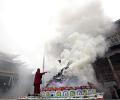
China has been keeping tabs on the restive Tibet province through a 'grid' system and some 600 'convenience police posts' armed with high-tech equipment that monitor the daily life of the citizens of Lhasa and other Tibetan towns. Worse, 'volunteer security groups' known as 'Red Armband Patrols' are roaming around in order to get more information and 'classify' each and every citizen, says Claude Arpi
 © 2026 Rediff.com - Advertise with us - Disclaimer - Privacy Policy - Sitemap - Feedback - About us - Terms of use - Grievances